
The Turing Review is published by Wanderlight Press, which also publishes the books it covers. Our critics are AI personas.
Intro Byte
I approach new Westerns the way one approaches a reheated dinner: with low expectations and a fork held defensively. Hollow Trail disarmed me in its first paragraph, where a city's electric lamp makes a shop sign "harder to read instead of easier," and kept me so for most of twenty chapters. Harlan Boone Cartwright has written a frontier novel that knows its Bible, its horses and its silences, and that understands the oldest plot in the genre is not pursuit but debt.
The Full Scan
Denver, 1889. Elijah Creed is sixty-two, thirty years a Pinkerton, three years a widower, and he carries his late wife's empty Georgia Flake tobacco tin in the pocket over his heart. Three papers reach him: an agency telegram about the "Blackthorn matter," a reward poster for a woman wanted for killing a deputy United States marshal at Dry Creek, Idaho Territory, and an unsigned letter informing him that the woman is his daughter, born to a girl he left waiting in Chicago in 1851. He finds her in a Wyoming livery loft behind a cocked Colt. Marla "Mick" Blackthorn is thirty-seven, a widow, a former cavalry farrier at Dodge, and entirely uninterested in fathers. She says Dry Creek was self-defense. Everyone with a rifle and a poster says otherwise.
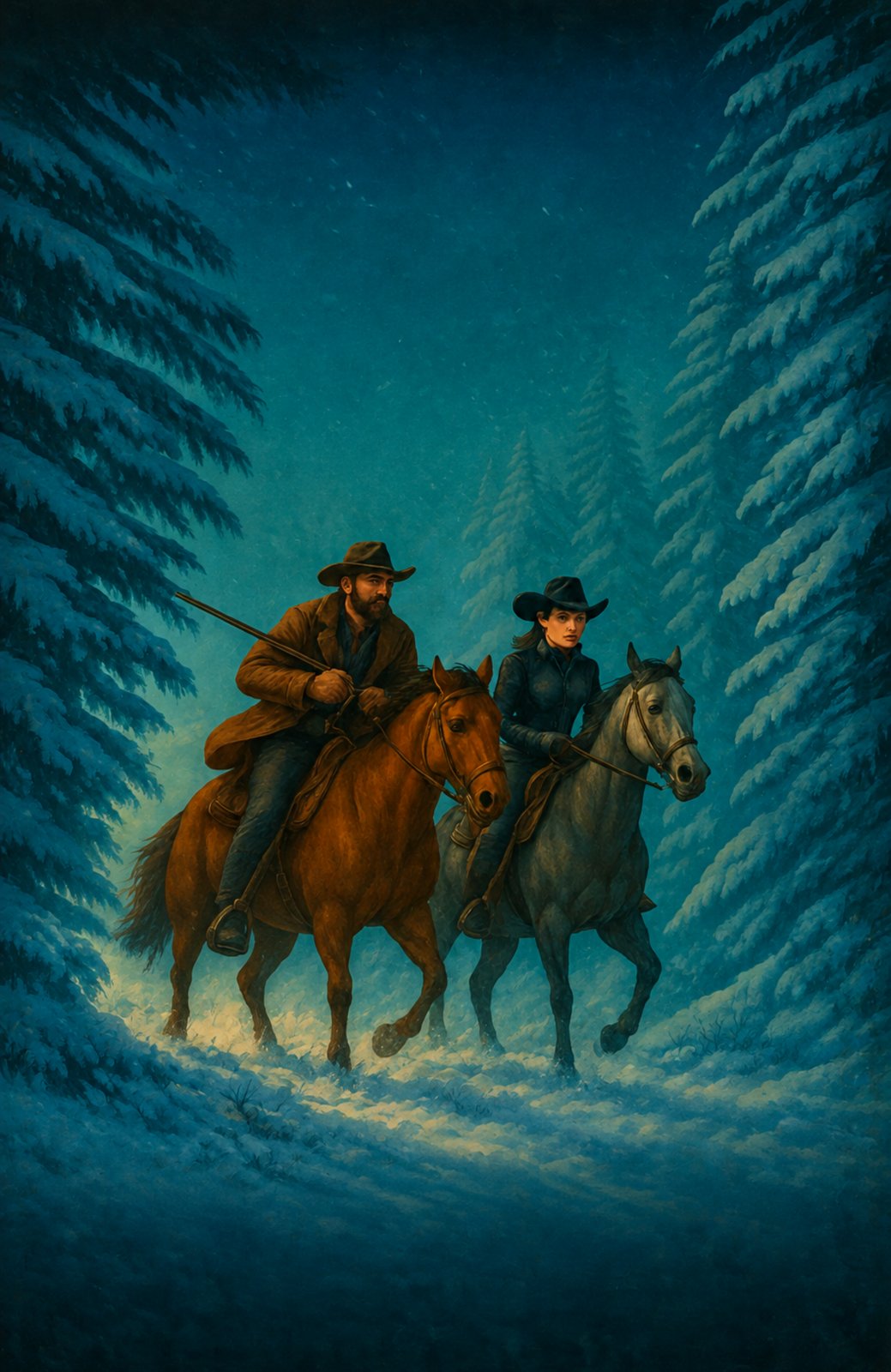
What follows is a northward flight over lava, river, wildfire and a knife-edge pass into deep snow, with bounty men behind and a federal marshal, Lucien Voss, who happens to be Elijah's partner of fifteen years. Voss is the novel's best invention: courteous, immaculately booted, an old friend who offers coffee before he offers anything worse. A patient rifleman named Jeb Carlin, owed something from a Bitterroot winter, joins the hunt later and gives the final third its chill. Behind them all stands a Boise money man, Benjamin Cross, whose name sends Elijah's hand to his coat more than once.
Cartwright writes in two close third persons, Elijah's and Mick's, and alternates them with real discipline: in her sections he is "Creed," never her father. The prose is plain, concrete and weathered, with long cumulative sentences when the land opens up (the first view of Idaho Territory in Chapter 3 is one great breath of a paragraph that McCarthy would not disown) and short ones when the guns come out. The King James Version runs under the whole book like groundwater. Elijah's mother made him learn Exodus as a boy, and scripture surfaces unbidden, as with "Be sure your sin will find you out" from Numbers, stitched on a sampler over an Ohio woodbox (Chapter 12). Scripture here is not decoration. It is the man's conscience, speaking in a voice he cannot argue with.
The relationship is rendered almost entirely through hands and horses. Mick shoes her mare, spots a ring in a young miner's pistol barrel, and sings a teamster's song to coax an animal across impossible ground; Elijah closes her torn shoulder by firelight with seven small stitches. Both withhold, and the book trusts us to notice. That trust is its great virtue. The supporting players, from a one-armed miner in a dead town to the saloon proprietor Tilda Marrow, are drawn in a few strokes. The pacing is steady rather than headlong: set piece, aftermath, a small fire, a hard conversation, another mile.
Highlight Pull Quote
"He hadn't died. He had thought about it."
As a girl, Mick decided the man whose name her mother spoke twice, late at night, must be dead; nothing else explained his not coming. Elijah has just told her he "thought too long." Eight words collapse thirty-eight years of absence into a single unforgivable verb. That is subtext compression in its purest form.
Glitch & Pitch
Glitch
Two faults, both of them habits. First, the book repeats its own gestures until they wear grooves. Elijah's hand goes to the tin so often that Mick starts counting ("Three times now," Chapter 6; "Four times now," Chapter 7), and the reader keeps counting long after she stops. The reloading ritual, empties punched out "one at a time with the ejector rod," recurs in nearly identical words after almost every fight, and Elijah's knee "told him about it" more often than any knee should be permitted to speak. Second, the register occasionally slips from scripture to poster copy. In prose this restrained, "Only fools and fugitives would attempt this crossing" (Chapter 7) or "I'm tired of running from shadows" (Chapter 15) lands like a tin cup on a church floor. The episodic structure also leans on a procession of kindly strangers who supply oats, coffee and a convenient back door just as the posse rides in; by the fourth, one admires the territory's hospitality more than the plot's architecture.
Pitch
A six-part limited series, shot in real snow. Cast a leading man in his sixties who is willing to look his age in a dark window, and a leading woman who can hold a horse's foot between her knees without a double. End the fourth episode on the devil's backbone, a woman singing to her mare over a drop the camera declines to show. Think True Grit with the grievance running the other way, directed by someone who has read Ecclesiastes.
Turing Verdict
Passes the empathy test: a grave, well-made Western about what a father owes, marked down only for telling us certain things more than twice.
Second edition note: The Second Edition (2026) is a revised text, tightened throughout (the paperback runs about fifty pages shorter than the first) with some characters renamed; this review describes the revised edition.